
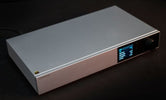
On the Importance of Preamplifiers – TOPPING Pre900 Flagship Pure Preamplifier Born for the Ultimate
by WishAudio
by WishAudio
The TOPPING 900 series flagship three-piece set perfectly embodies this concept: the D900 DAC, A900 headphone amplifier, and Pre900 independent preamplifier. Each unit performs its specific function, working together to push the "ultimate in separate components" to new heights. Last year we reviewed the D900+A900 two-piece set; this time, we'll focus on experiencing the new Pre900 pure preamplifier and assembling three complete systems to verify the decisive improvement in sound quality brought about by an independent preamplifier.

The pre-stage is the "soul" of the system.
A high-quality preamplifier not only determines the overall sonic direction, dynamic range, detail resolution, and soundstage framework of the system, but it is also the core source of sound control, serving as the tuning center and signal hub connecting the entire system. The larger the system and the more high-end the configuration, the more stringent the requirements for the preamplifier's overall quality, and gain matching capability is a crucial aspect that many audiophiles tend to overlook.
Pre900: A Pure Preamplifier Born for the Ultimate Experience
The biggest highlight of the Topping Pre900 pure preamplifier is its three adjustable gain levels: 0dB, 10.4dB, and 19.9dB, adaptable to the needs of all types of audio sources and backend equipment. The 0dB level approximates a passive preamplifier design with a low-gain buffer architecture, avoiding unnecessary voltage amplification and focusing on impedance matching and signal buffering to preserve the integrity of the original signal to the greatest extent possible, eliminating high-frequency attenuation and detail loss.

With three freely switchable gain levels, it can flexibly match modern high-level digital audio sources and older low-level analog equipment. Adjustments can be made according to the sensitivity of the front-end output and power amplifier input, ensuring the overall system's sound quality, signal-to-noise ratio, and dynamic performance are always at their optimal balance. Meanwhile, the Pre900's ultra-low output impedance of only 100Ω ensures high-frequency loss and a clear soundstage even during long-distance signal transmission. It drives various power amplifiers and even active speakers with exceptional ease and stability, delivering high signal purity and a clean, deep sound, truly achieving versatility across all audio sources, power amplifiers, and speaker systems.

Pre900 uses a relay array and a high-precision resistor network to achieve 1,000-level step adjustment. Each level of volume switching is smooth and natural; channel crosstalk is as low as -150dB. At any volume, the left and right channels always maintain synchronization accuracy, and the sound field positioning is accurately restored. The entire process adjusts the volume, but the sound quality remains unchanged.
The preamp itself is extremely sensitive to signal interference. The signal management and isolation design of Tuopin Pre900 is completely based on the approach of high-end Hi-Fi preamps. From input source switching, signal buffer isolation, to interference shielding between the front and rear stages, we have fully optimized it to isolate the crosstalk between the audio source and the rear stage to the greatest extent, making the transmission purer and the entire system more stable. To put it simply, the decoder is responsible for restoring digital signals to high-quality original sound, while the high-quality preamp is responsible for transmitting the sound losslessly. Without a high-quality preamp, no matter how strong the decoder and post-amplifier are, it will be difficult to realize their true potential.

The Pre900 features only one pair of XLR balanced output interfaces to ensure an optimal signal path. It also supports 12V trigger input/output, allowing for seamless integration with upstream and downstream devices and one-button system startup. Sound quality is not sacrificed for redundant features; pure listening is the ultimate goal.
Compared to gain adjustment, volume control and linear amplification are the most challenging aspects of designing a high-end preamplifier, considered the lifeblood of the entire system's sound quality. Traditional potentiometers are prone to distortion and channel imbalance during adjustment, and long-term use can lead to poor contact and volume drift. The Topin Pre900 directly adopts a relay + high-precision resistor network stepping volume architecture, a standard feature in high-end preamplifiers. During adjustment, the relay engages and switches in stages, providing precise stepping and extremely high consistency between the left and right channels. This achieves lossless, uncolored 0.1dB volume precision (1000 steps) control and an astonishing -150dB channel crosstalk. Even at low volumes, the sound remains balanced, delicate, and layered, completely free of distortion and tone imbalance.

The Pre900 employs a four-channel reference-stage amplifier circuit, which is not only fully balanced but also features a fully differential design from input to output. This maximizes the physical isolation between the left and right channels, effectively suppressing noise and external electromagnetic interference, resulting in higher sound purity.

In terms of circuit architecture, the entire unit uses a fully differential balanced circuit design, with physical isolation between the left and right channels. The analog and digital power supplies are completely separated, suppressing electromagnetic interference and crosstalk at the source. As a result, the overall noise floor control is extremely excellent, with a deep and quiet black background. Subtle whispers, reverberations, and spatial overtones in music are clearly revealed, fully showcasing the transparency, purity, and delicate nuances expected of a pure preamplifier.
The Pre900's digital and analog circuits are powered completely independently, each performing its own function without interfering with the other. This effectively reduces power crosstalk at the source, ensuring that the background noise is barely perceptible during high dynamic output, the background is as dark as ink, and the musical details leap out.


